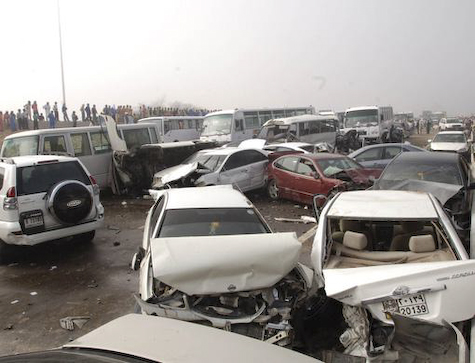
Minor fender-bender in Dubai
One of the earlier jobs I did with the Auckland HEMS proved to be one of the most educational for me. The paramedic and I were tasked to an MVA with two patients. On arrival we discovered there were actually five patients – two with abdominal injuries and abnormal vital signs, one with an open femur fracture, one with a trivial head injury but anti-coagulated, and one with minor injuries. Several St Johns ambulance crews were already on scene, and managing things admirably. The two patients with abdominal injuries were transported by helicopter (this proved to be the correct decision), but as a doctor not familiar with chaotic scenes and multiple patients, I learnt some valuable lessons:
1) Doctors and paramedics assess patients differently
Initially the paramedic and I attempted to ‘divide and conquer’, with us splitting the patients between us for initial assessment. Coming from different backgrounds, the focus of our assessments was different, with the result being that I ended up assessing his patients as well, and he ended up assessing mine. This was clearly inefficient.
With the main function of the HEMS doctor being to provide additional resuscitation and medical skills to patients who need them, a more efficient way of us assessing which patients would benefit from my intervention would have been for us to briefly assess all five together, identify the two sickest for helicopter transport, and leave me to manage/package them while the paramedic assisted the ambulance officers with scene management and care of the other patients, who were destined for road transport. There would be a clear exception to this however when the scene controller directs the doctor to the sickest patient(s) on helicopter arrival.
2) Doctors need to be familiar with ambulance hierarchies and skill mixes
Some of the St Johns staff on scene were volunteer ambulance officers without the authorisation to perform certain interventions (giving morphine or splinting the femur fracture for example). I was unaware of this, and mistakenly assumed that such interventions would be taking place without input from the helicopter paramedic, myself, or the senior paramedic at the scene. The fact that these interventions did not happen at the time I assumed they would contributed to my perception of chaos (I take my hat off to paramedics who do this regularly!). ASKING about the skill set of ambulance officers is crucial to ensure that the patient gets the right care at the right time with maximum efficiency – assume nothing!
3) A scene with multiple patients provides significant equipment challenges
The HEMS doctors bag that we carry contains equipment for advanced medical interventions and surgical procedures. It is NOT well suited to more basic first aid functions, obtaining IV access, providing analgesia, and commencing IV fluid. For the patients at this scene, interventions like this were all that were required pre-hospital. With patients spread apart over the scene, several raids on the Thomas pack were required – this was time-consuming and inefficient. Our equipment needs work to make it more amenable to splitting it between multiple patients, but in the interim I now carry a small pack in my pocket with some basic equipment (cannulae, leur locks, flushes, drawing-up needles, gloves, tape etc). A thigh pouch has also made its way into use.
4) With two stretchered patients in the helicopter, intervention is difficult
The two patients we transported were both on stretchers wearing cervical spine collars. the paramedic and I were tucked at the front under a hefty pile of equipment. Performing any significant intervention on a patient in-flight would have been virtually impossible. If a patient is unwell enough to require significant intervention in-flight, the risks and benefits of taking a second patient on the same flight need to be seriously considered.




 Auckland HEMS