From the SMACC 2013 conference – this podcast is Dr Brian Burns (Greater Sydney Area HEMS) speaking about managing trauma patients in extremis and in extreme conditions
One of the challenges of resuscitation and pre-hospital medicine is that there are multiple high-risk but rarely performed procedures that clinicians must be ready to perform. The difficulty is that we may go our entire careers and only perform them once or even more likely never. However, the difference from success and failure for these procedures can mean life or limb. Consequently we must remain competent despite the challenges with practice. There is an excellent article that articulates these issues by Cliff Reid & M Clancy which I highly recommend reading (for anyone interested in the topic).
(a primer video I integrated into a recent cric teaching session to get our participants into the mood!)
These life-saving, rarely performed procedures happen to be an interest of mine. It’s a fascinating exercise in education and cognition to maintain competence in performing these procedures yet have virtually no real-life patient practice. The likely result is that clinicians are not competent or they do not remain competent in performing them. More optimistically, some clinicians will maintain their skills through simulation. However, I would bet that a survey of most staff emergency physicians would reveal virtually no hands on practice of many of these life-saving procedures. One of the most talked about and important of these procedures is the surgical airway (or cricothyroidotomy). This is only performed when a patient who requires emergency airway management but they cannot be intubated or ventilated. For most of us, we’ll go through our careers never performing one. But every time we intubate a patient, there’s a risk that this scenario could develop and we’ll have to act accordingly.
At ARHT last week, I ran an inter-professional session for the paramedics, doctors and crewman on surgical airway performance (or cricothyroidotomy). The goal was to integrate our new cricothyroidotomy task trainers into the educational curriculum and combine them with some group discussion and simulation. For those looking to do replicate the event or simply looking for ideas, I will outline our session.
In addition to the introduction of our new task-trainers we also used this opportunity to review our performance of surgical airway. From an educator’s perspective, the most important step for success of this session is preparation. Those who know me, know that I’m not a detail oriented person but planning for everything from big picture stuff to the smallest detail can make a huge difference. In an effort to encourage the sharing of information (FOAMed) I’ll describe our itinerary.
Before the session I sent 2 emails. Our group is relatively new to the flipped classroom, or sending material first then promoting discussion within the classroom/learning site. Something I took home from SMACC 2013 is start with videos (easy to digest material) if you’re implementing a flipped classroom approach for the first time. A follow up email was sent with the videos again and this time along with 2 articles:
The MOST important aspect was to outline the ground rules and expectations. In our case, we were not using this session as an evaluation but instead as an opportunity to practice and engage our entire team. If you are evaluating learners, let them know!
We used both task trainers and simulation to ensure an environment that promotes psychological safety and learning for all participants
Content Presentation (using powerpoint)
I kept this short – about 20min so that everyone remained engaged (some of our doctors have fairly short attention spans!)
Review the indications (contraindications…not really any), complications and considerations in performing a surgical airway
Review the controversies regarding surgical airway (more to come on this in a later post)
preferred technique (surgical vs. percutaneous)
vertical vs. horizontal incision
team positioning
Integrated 2 videos – the impact of engaging the audience is impressive…especially when you have the luxury of using some pretty amazing footage
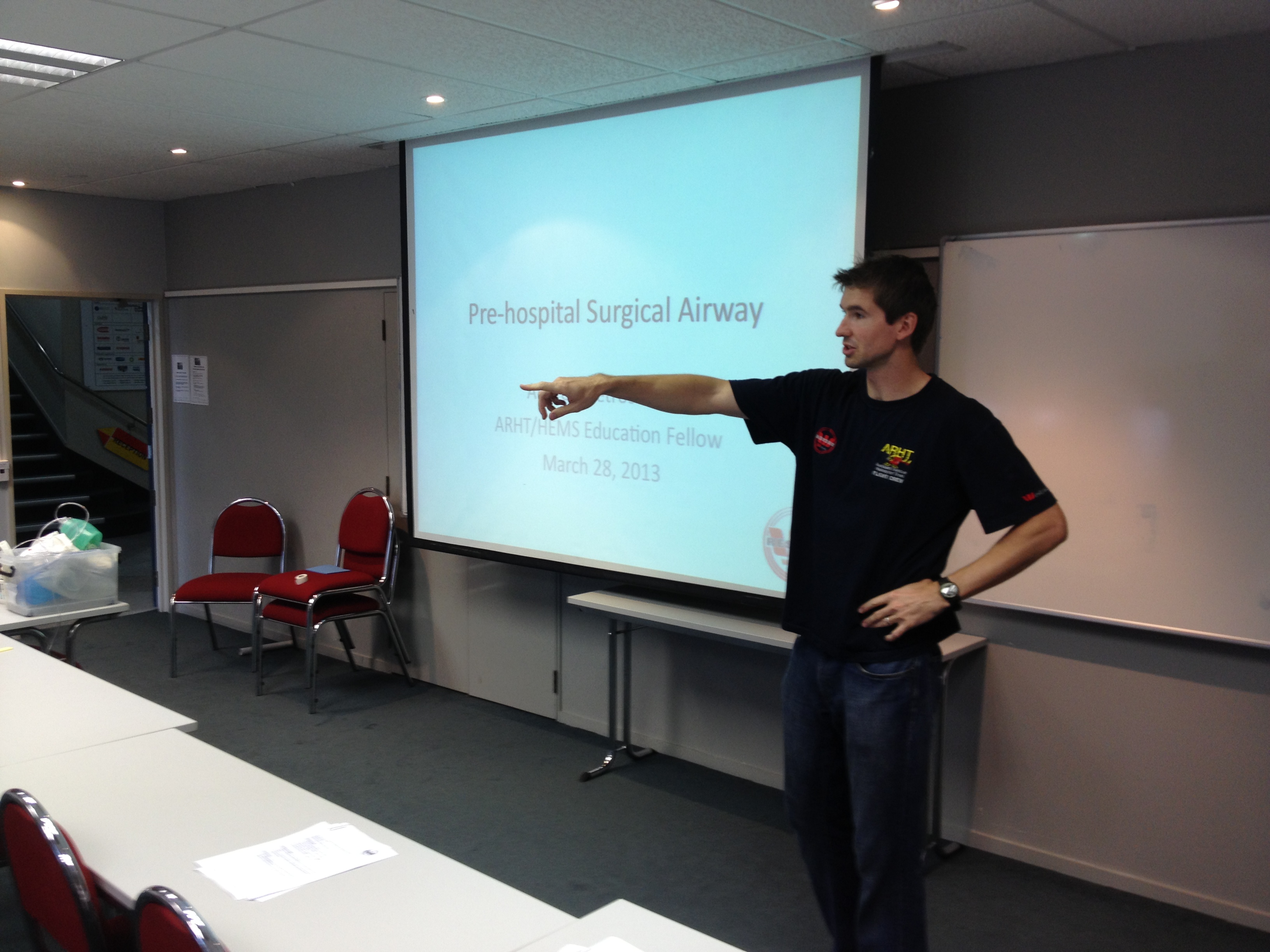
No better way to encourage participation than some pointing and asking people directly! (not my finest picture during a lecture…)
Task Trainers
We had 3 stations of task trainers with inter-disciplinary teams (paramedic, doctor, crewman)
Teams rotated every 15 minutes
Station 1 – pediatric needle airways
Station 2 – open/surgical cricothyroidotomy using a variety of tools & instruments
Station 3 – participants were blindfolded, relying on their tactile sense and team communication to complete the procedure
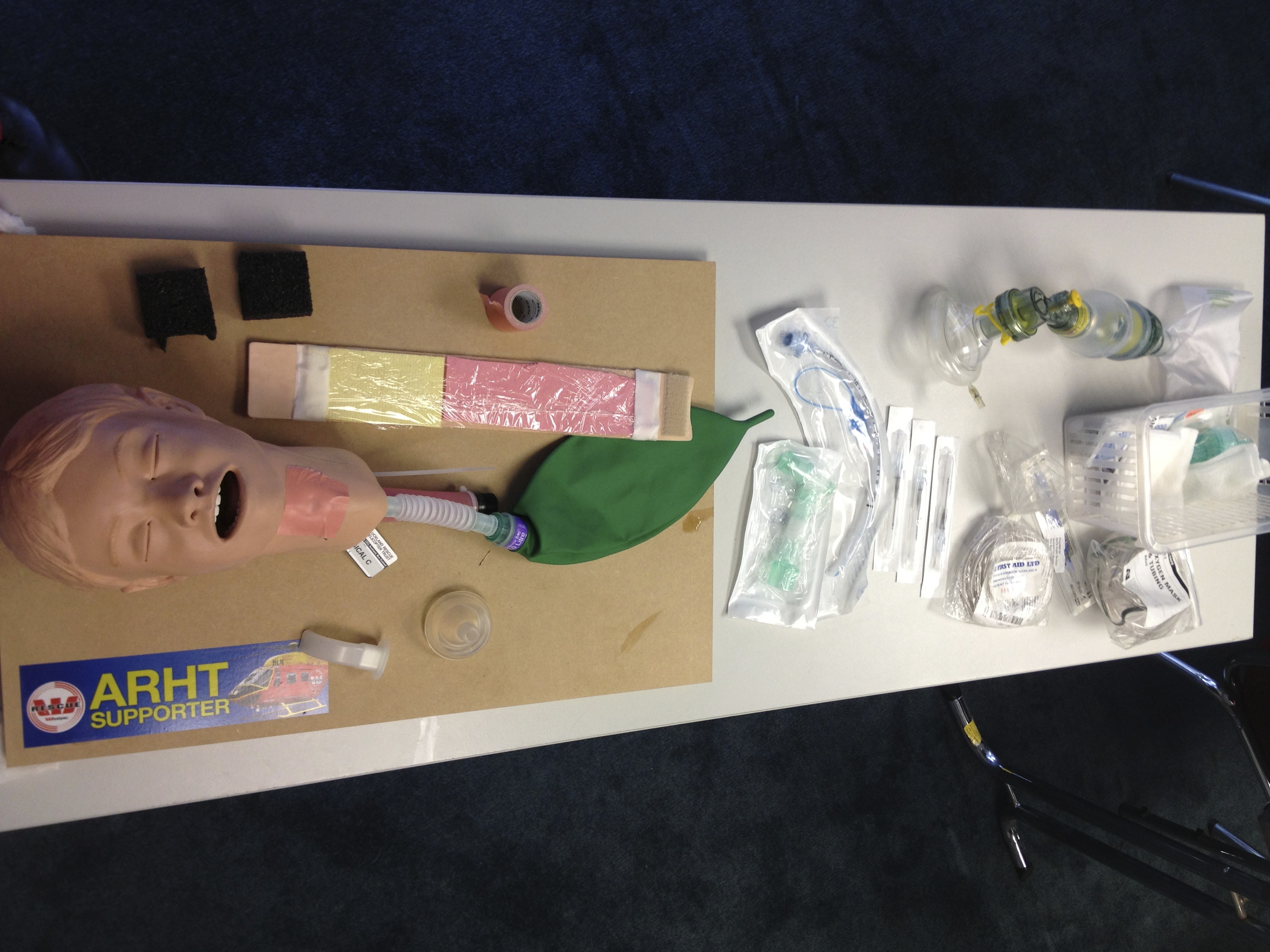
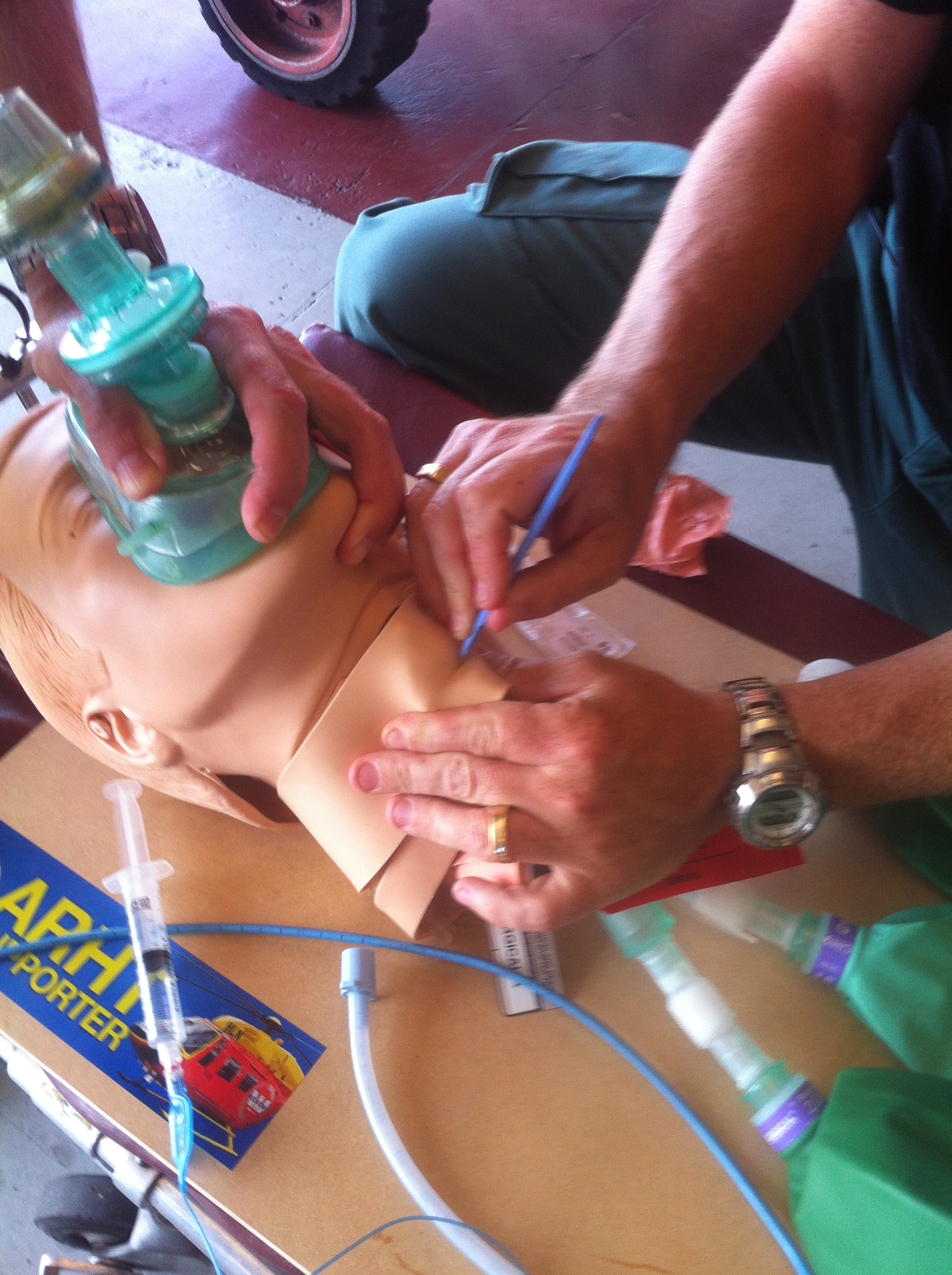
Our cric station set up. A variety of equipment that allowed participants to try various methods
Our crew practicing a surgical airway on a task trainer
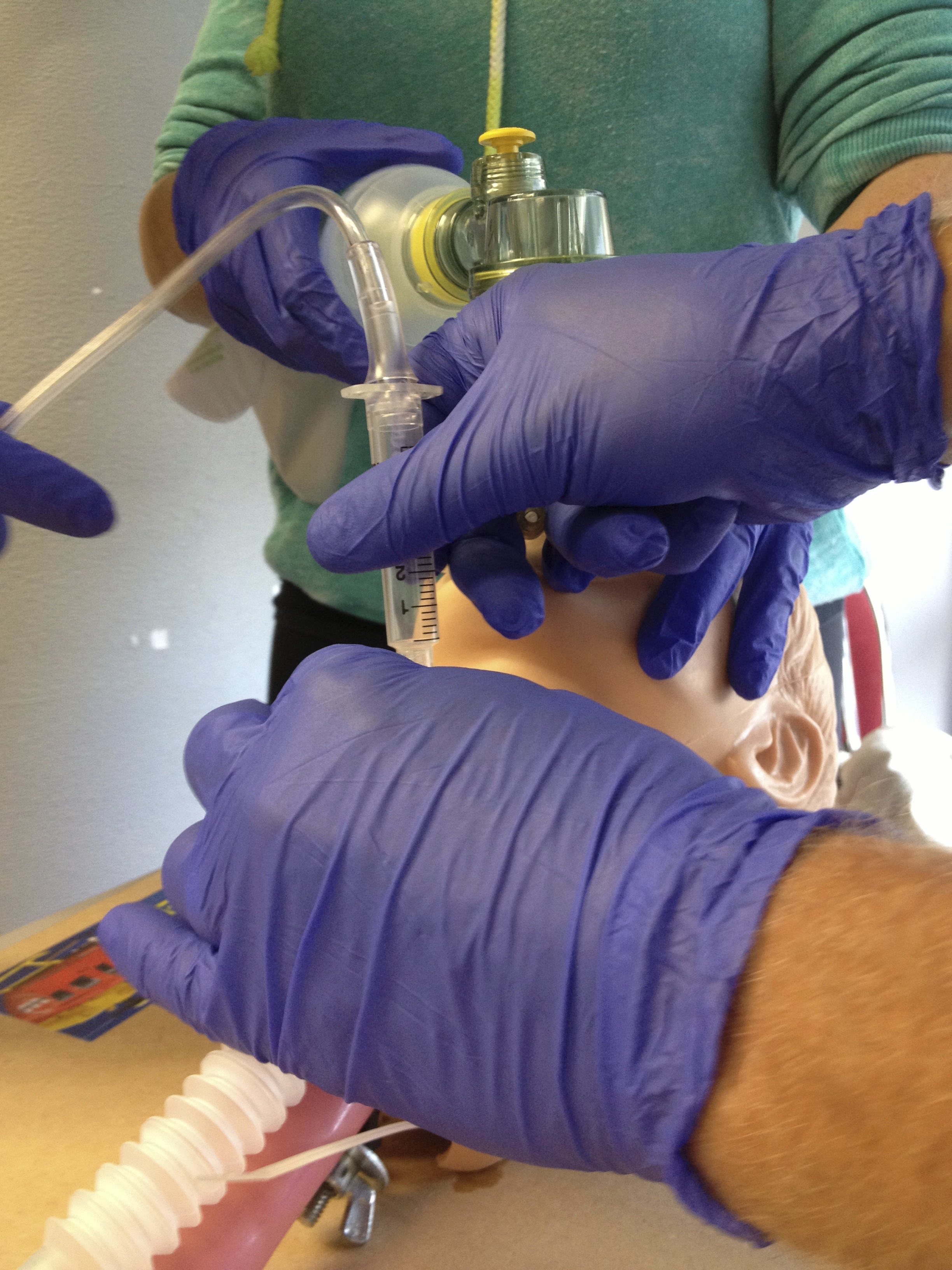
Several participants trying out a needle jet ventilation techniqu
Brainstorming session
While we already have a cric kit in our packs, we used this opportunity to discuss the equipment that participants used in the task-trainer session
Then we packed a cric kit following this discussion (based on consensus) for a team to use in the next section – an outdoor simulation
This usablity testing allowed participants to directly observe their decisions for kit composition in practice!
Simulation
3 volunteers (crewman, doctor, paramedic) representative of our duty crew at ARHT
Participated in a simulation of a patient with a trapped patient, unable to be extricated and deteriorating mental status and respiratory status. There was considerable
Debriefing after the manikin was successfully rescued from under the trailer! He got a cric and was ventilated by our team! Disclaimer…no manikins were harmed during this educational session (except a few cuts to their necks)
Debriefing
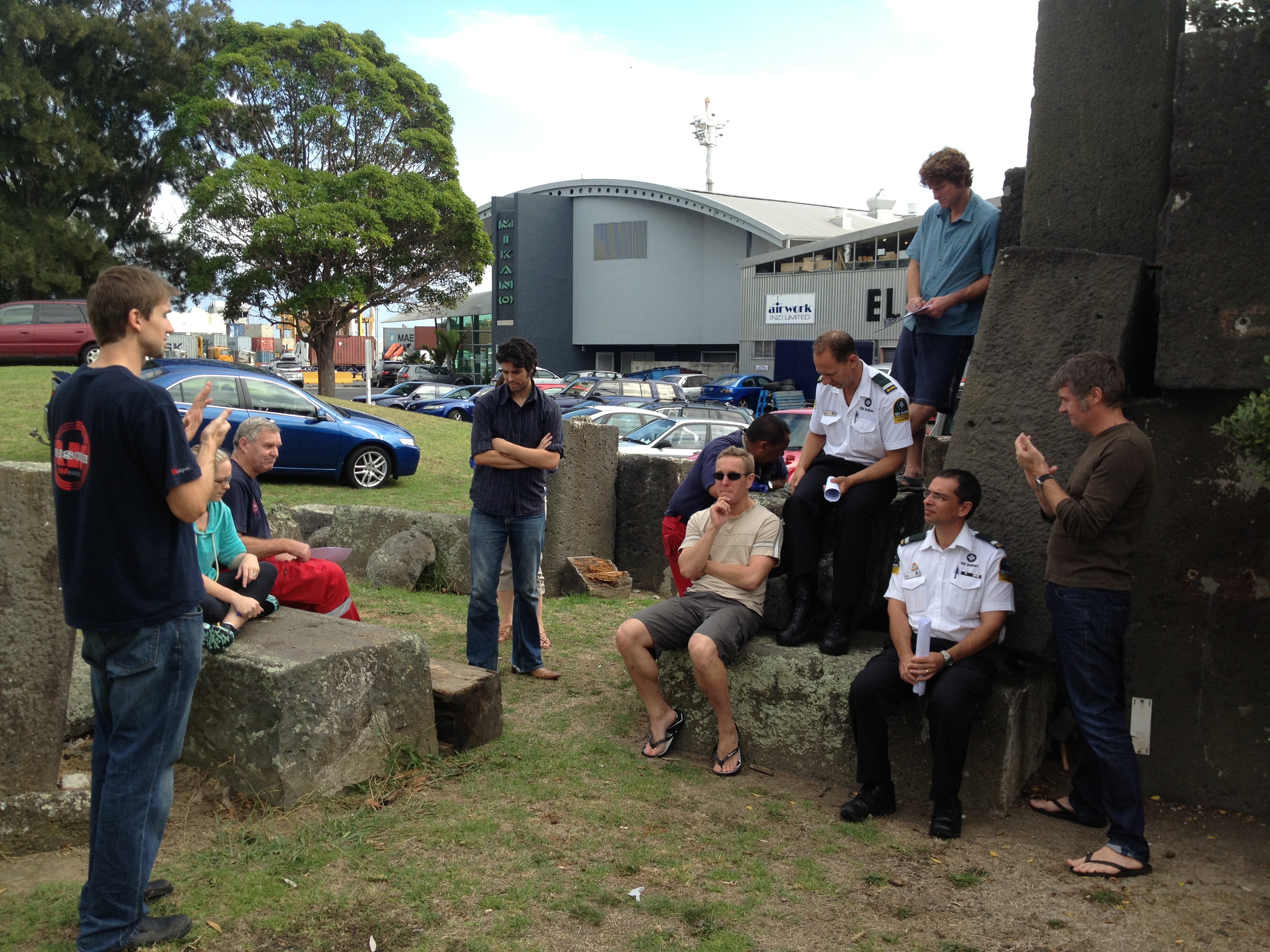
Debriefing of the simulation and the entire day
We used this opportunity to ask participants what equipment, methods and preferences they would like integrated into our standard operating procedure
This entire process included usability testing for participants – allowing them to use different techniques & equipment they may otherwise not try. This also provides an additional opportunity for inter-professional education that is extremely important for such a high risk, rarely performed procedure. Proper planning and training for all team members involved will only make the process better.
The authors of a recent study tried to answer this question. The authors evaluated patients who got needle decompression in the field using prospective, observational methodology (though I wonder if truly prospective given the lack of data). Anyways, they noted that in their population very few patients (5/52 decompressions) escaped without requiring a follow-up chest tube. Only 1/15 penetrating trauma patients did not get a chest tube. A few important questions remain including how many of the needle decompressions actually reached the pleural cavity or the technique used for decompression (appears later in Q&A that it was probably anterior axillary line).
The authors conclude to have a low threshold for chest tube insertion based on CXR however, not shockingly a CT chest will provide more information. This study certainly doesn’t support withholding a chest drain if needle decompression is performed in the field. There was a nice suggesting by another surgeon who commented they leave all the needles in place during CT scan to see if it actually reached the pleural cavity. For the stable patient that doesn’t need immediate intervention, this is probably sound advice. Wait for the CT then make decision based on clinical and radiographic data.
There should probably be further study on this topic but for now, this is all we have! Here’s the abstract below.
Is routine tube thoracostomy necessary after prehospital needle decompression for tension pneumothorax? KM Dominguez et al. Am J Surg 2013; 205(3): 329-332
BACKGROUND:
Thoracic needle decompression is lifesaving in tension pneumothorax. However, performance of subsequent tube thoracostomy is questioned. The needle may not enter the chest, or the diagnosis may be wrong. The aim of this study was to test the hypothesis that routine tubethoracostomy is not required.
METHODS:
A prospective 2-year study of patients aged ≥18 years with thoracic trauma was conducted at a level 1 trauma center.
RESULTS:
Forty-one patients with chest trauma, 12 penetrating and 29 blunt, had 47 needled hemithoraces for evaluation; 85% of hemithoraces required tube thoracostomy after needle decompression of the chest (34 of 41 patients [83%]).
CONCLUSIONS:
Patients undergoing needle decompression who do not require placement of thoracostomy for clinical indications may be assessed using chest radiography, but thoracic computed tomography is more accurate. Air or blood on chest radiography or computed tomography of the chest is an indication for tube thoracostomy.
With over half the Auckland HEMS team coming from a hospital that serves age 15 and up (and therefore not dealing with children on a daily basis), prehospital management of paediatric patients is a field to which we must pay considerable attention in our training. Simulation exercises have included paediatric scenarios on several occasions – our thanks to Mike Shepherd and Trish Wood from Starship Hospital for their assistance!
Below are some useful resources regarding prehospital care of paediatric trauma patients:
Podcasts from Dr Jeffrey Guy, Medical Director of PHTLS (right-click to download)
(he has also produced other PHTLS podcasts – found here)
A 2012 review of prehospital paediatric trauma from the Harbourview Medical Centre in Seattle can be found here. Take-home messages:
falls and MVA are the most common causes of paediatric trauma morbidity
despite a lot of research and intervention paediatric trauma patients are under-resuscitated on arrival compared to their adult counterparts
children have very different airways anatomically to adults; with full cervical spine immobilisation airway view can be improved with a towel under the shoulders to bring the neck into a neutral position
with a higher surface area/size ration children are more prone to hypothermia
due to their smaller blood volume a small amount of blood lost can represent a large percentage of their blood volume
contrary to traditional teaching, cuffed ETT are increasingly used at half a size smaller than the appropriate uncuffed ETT

 Auckland HEMS