Ever done an RSI in a helicopter? Here’s a recent simulation experience!

Recently at the base, we’ve been discussing the concept of improving our ergonomics and making our workspace (e.g. the helicopter) as functional as possible. We are continually looking to optimize our equipment to best serve our patients.  Any procedure in-flight will be considerably more difficult than if performed in a well controlled environment like the hospital so in-situ training within the helicopter is essential.

Today, Karl (one of our advanced paramedics) and I did some in-situ simulation of an RSI within the helicopter. We ran through a scenario with an unpredicted deterioration of a patient in flight that required an RSI. A review of the literature provides little guidance on the emergency airway management of patients while in-flight so approaches to such situations currently must be derived from simulation and retrospective reviews within your own program.

We discussed a few key concepts that should be considered as we move forward in pre-hospital airway management and overall care for acutely ill patients:

1. Patient positioning: ample evidence that patient’s should probably have some head elevation if possible during intubation (If you don’t believe me…check out this must read paper). This IS possible within the BK and it actually provided Karl with the best view when it was up near 40-45 degrees! Check out the following pics which demonstrates feasibility within the BK.
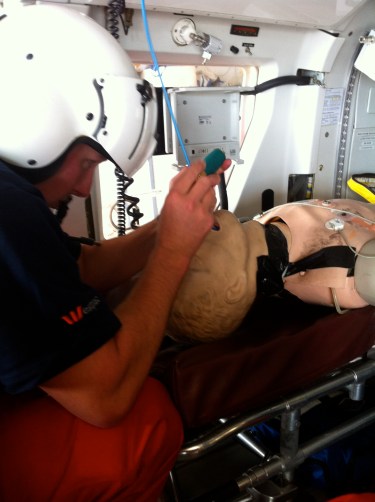
Patient is fully supine. Experts advocate "ear to sternal angle" but in our traditional position of supine you'll note that the ear is NOT at the sternal angle!

Patient is fully supine. Experts advocate “ear to sternal angle” but in our traditional position of supine you’ll note that the ear is NOT at the sternal angle!

And now, for a clear demonstration of “ear to sternal angle”. A position we should strive to do either to avert intubation or in preparation of an advanced airway.

A picture perfect view of the cords!

A picture perfect view of the cords! Patient at 40 degrees, and still able to intubate with a great view…even with the helmet on. Let’s integrate this!

2. Pack position: we decided that the airway/BMV pack would be removed from the Thomas pack and given to the intubating clinician immediately upon patient deterioration. This allowed the paramedic to have all necessary equipment for excellent airway management. The physician could then focus on drug administration and clinical decision making. We opened the Thomas pack fully beside the physician and placed the drug pack on the patient’s legs.

Note the drug pack on the patient's legs and the Thomas pack spread out to the right of the physician. This worked best in our setting.

Note the drug pack on the patient’s legs and the Thomas pack spread out to the right of the physician. This worked best in our setting.

Here’s what DIDN’T work.
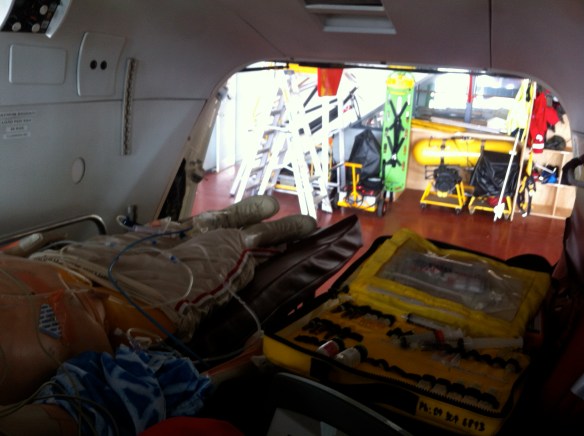
This set up was very cumbersome if the drug pack is lying on a partially open Thomas pack. Another issue was the Thomas pack was still upright...and not lying flat.

This set up was very cumbersome if the drug pack is lying on a partially open Thomas pack. Another issue was the Thomas pack was still upright…and not lying flat. Also harder since we had to turn each time to get drugs rather than in front.

3. Apneic oxygenation: this is a bit trickier and something we’ll have to look at more closely to see what would be feasible since it will require 2 O2 sources. It was definitely challenging to get it set up when time constrained. (another must read paper on the value of apneic oxygenation).

Huge thanks to Karl for running through the sim case and providing value feedback on the ergonomics of the situation…what worked and what didn’t! We will all learn from this.
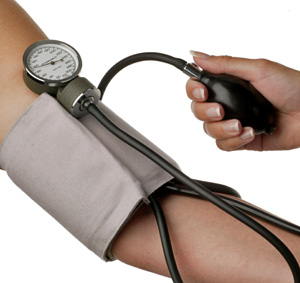
What’s the accuracy of noninvasive BP in flight?

This question was recently studied by a group from the UK. They compared noninvasive blood pressure (NIBP) with intra-arterial blood pressure measurements (IABP) at several points including pre-flight and in-flight. They did some complex statistics to study the levels of agreement between the two measurement methods.

high_blood_pressure

This is something that is directly relevant to us at ARHT. While it doesn’t apply to all of our patients, we do transport a significant minority who are critically ill – where BP must be accurately measured.

The authors report, not surprisingly, that the NIBP was quite variable and often didn’t correlate well with the IABP both pre-flight and in-flight. But the take home point in their conclusion is that the non-invasive MAP is closer to the IABP. The authors conclude:

From our results, IABP monitoring should be used in any unwell patient in whom accurate blood pressure measurement is desirable. The general inaccuracy of the NIBP measurements obtained dictate that IABP monitoring should remain the accepted ‘gold standard’ of care in any critical care environment. Notwithstanding this, in our study, the aeromedical transport environment does not lead to less precise NIBP results than the non-transport environment. Thus, we conclude, where NIBP measurement is the only option, that the mean blood pressure should be used in preference to systolic measurements

*bold is my emphasis

Source McMahon N et al. Anesthesia 2012; 67:1343-1347. Comparison of non-invasive and invasive blood pressure in aeromedical care

Is there more to meets the eye to pre-hospital intubation than just a tube?

In a recent review of the literature about pre-hospital intubation in traumatic brain injury (TBI) and the potential impact of hyperventilation, Gaither et al. explore the potential confounders for outcomes in previous studies. 

The authors provide a nice overview about the “old school” rationale for hyperventilation in TBI and why it is unlikely a good idea!

Why hyperventilation thought to be beneficial in TBI: 1) decreases arterial PaCO2 with CNS vasoconstriction 2) decreased cerebral blood flow. Net result is improved cerebral perfusion pressure (CPP). However, hyperventilation after intubation may increase intrathoracic pressure, increase JVP and subsequently decrease CPP. Hypocarbia may also lead to free radical formation and cellular damage. So net result is PaCO2 of 25 isn’t a good idea! Probably best to target into something like 35.

The authors then outline the historical concerns about pre-hospital intubation (low success rates, long scene times and complications like hypoxia). However, they argue that perhaps its not the intubation itself that may confound these “worse” outcomes, but perhaps the greater potential for hyperventilation! And the detrimental effects may in fact occur post-intubation.

There’s some evidence that in pre-hospital settings where end-tidal CO2 is closely regulated (assuming high intubation success…which probably requires well-trained personnel) that patients do better if they’re intubated…just so long as we keep their ETCO2 under control! The following is a direct quote from the article:

There is a strong possibility that the negative effects of intubation that have been identified in several clinical trials may be due to a paradox: intubation may protect the airway and prevent hypoxia, but it also makes it easier to inadvertently hyperventilate. Consequently, although intubation is intended to reduce secondary brain injury, it may enhance it if specific, intentional measures are not taken to ensure proper post intubation ventilation

A nice conclusion is provide (which I fits well within the general tone of the article).

When properly performed, intubation is effective for airway protection and ensures adequate oxygenation; it also makes hyperventilation (and associated negative outcomes) easier and more likely. Optimal outcomes require choosing the right patients, achieving the highest success rates through training, and avoiding hyperventilation after intubation in patients with traumatic brain injury

This article makes a great case for well trained medical personnel who perform pre-hospital intubations and then provide the best post-intubation care possible.

Full text pdf is available here (secure area limited to ADHB staff only – ADHB has subscription access for staff to these journals through the Philson Library at the University of Auckland School Of Medicine)

Paramedics in high-stress simulation: performance may be affected

In a recent study from Toronto, researchers studied paramedics in two similar scenarios. Both scenarios involved a 50 year old patient suffering from chest pain. The patient develops pulmonary edema, hypotension and an ECG reveals a STEMI. All study participants (paramedics) performed interventions based on their established local protocols.

In the “high stress” scenario, there was an actor playing the patient’s partner who was visibly distressed and challenging the paramedic’s actions. Also, all alarms were turned up to full volume and there was constant 2-way radio communication going on in the background. None of this occurred in the “low stress”  scenario.

Paramedics were assessed using a global rating scale, a checklist scale and their salivary cortisol levels were measured before and after each scenario (as a response to stress).

The authors noted that “When faced with clinically relevant stressors, paramedics demonstrated significant increases in subjective (anxiety) and physiological
(salivary cortisol) measures of stress. These stress responses were accompanied by impairments in some aspects of clinical performance and in the ability to accurately recall information from the case. Although the paramedics demonstrated no impairments in
their ability to complete each individual action required for the particular scenario, decreased scores on the global rating scale indicate that overall they did so more poorly, with less organization and poorer communication or interpersonal skills.” 

Overall, paramedics did feel more stressed in the “high stress” scenario – this was measured both by a survey and cortisol levels. And while they were able to complete all relevant tasks, their global performance assessment was reduced as was their ability to recall specific case details.

Fascinating study! We must recognize the high potential for error among clinicians when faced with stress.This data should guide us towards the increasing use of emergency checklists so that things are not forgotten in stressful environments,  Such findings will lead nicely into a new video by Scott Orman about the use of whiteboards in handovers and the potential for inaccurate data transmission (unless there’s protocols in place to document better!).

These authors also did a similar study with residents – with similar findings! We need to do better as clinicians & educators in recognizing stress as a huge factor leading to errors and implement interventions to manage these potential threats and errors.

Here’s the abstract

The impact of stress on paramedic performance during simulated critical events.Prehosp Disaster Med. 2012 Aug;27(4):369-74. Epub 2012 Jul 25. Leblanc VR, Regehr C, Tavares W, Scott AK, Macdonald R, King K.

Abstract

OBJECTIVES:

Substantial research demonstrates that the stressors accompanying the profession of paramedicine can lead to mental health concerns. In contrast, little is known about the effects of stress on paramedics’ ability to care for patients during stressful events. In this study, we examined paramedics’ acute stress responses and performance during simulated high-stress scenarios.

METHODS:

Twenty-two advanced care paramedics participated in simulated low-stress and high-stress clinical scenarios. The paramedics provided salivary cortisol samples and completed an anxiety questionnaire at baseline and following each scenario. Clinical performance was videotaped and scored on a checklist of specific actions and a global rating of performance. The paramedics also completed patient care documentation following each scenario.

RESULTS:

The paramedics demonstrated greater increases in anxiety (P < .05) and salivary cortisol levels (P < .05) in response to the high-stressscenario compared to the low-stress scenario. Global rating scores were significantly lower in the high-stress scenario than in the low-stress scenario (P < .05). Checklist scores were not significantly different between the two scenarios (P = .12). There were more errors of commission (reporting information not present in the scenario) in the patient care documentation following the high-stress scenario than following the low-stress scenario (P < .05). In contrast, there were no differences in omission errors (failing to recall information present in the scenario) between the two scenarios (P = .34).

CONCLUSION:

Clinical performance and documentation appear vulnerable to the impact of acute stress. This highlights the importance of developing systems and training interventions aimed at supporting and preparing emergency workers who face acute stressors as part of their every day work responsibilities.

Full text pdf is available here (secure area limited to ADHB staff only – ADHB has subscription access for staff to these journals through the Philson Library at the University of Auckland School Of Medicine)