The importance of simulation in usability testing and hazard identification

photo-14

Auckland ED is conducting a lot of simulation training currently, with a recent focus on airway management.

Last week a teaching session was delivered by Sam Bendall (an Auckland HEMS doctor) on ‘intubation as a team sport’, which covered human factors in ED airway management and included the use of adjuncts like airway checklists. While Auckland HEMS has an RSI checklist, a similar tool has not been finalized for Auckland ED – this is under consideration currently. Following that teaching session, several airway checklists had nonetheless made their way into our resuscitation areas.

High-fidelity simulation training took place this afternoon, led by Sam, Mike Nicholls (another HEMS doctor), and Nancy Mitchell (Nurse Educator).

The first scenario involved a relatively junior team undertaking an emergent RSI. They performed admirably, and the outcome in practice would have been safe and successful. As an observer however, it was apparent that an airway checklist would have contributed to their confidence and comfort levels. (My personal opinion is that we should start using a checklist for ALL ED RSIs, independent of team seniority)

While watching the simulation I spotted a checklist taped to a whiteboard on a side wall. I assumed that was the airway checklist, and thought ‘that’s a clever position – it means the airway assistant can read out the checklist immediately prior to the RSI. They haven’t used it, I must bring this up at the debrief’.

At the end of the debrief, I inspected what I thought was the airway checklist, and found this:

HCA checklist

It wasn’t an airway checklist at all, but a restocking checklist!

The actual airway checklist was here…

photo(3)

Tray following RSI (this is NOT how we set up!) Airway checklist bottom left

taped to the top of the airway trolley (logical) but unfortunately covered up by the airway tray, which is removed from the trolley and placed on top when setting up for airway management. This is a good example of a latent hazard.

I found a second copy of the checklist taped to the desk at the entrance to the resus bay – this is where the scribe (usually one of the senior nurses) stays during a resuscitation:
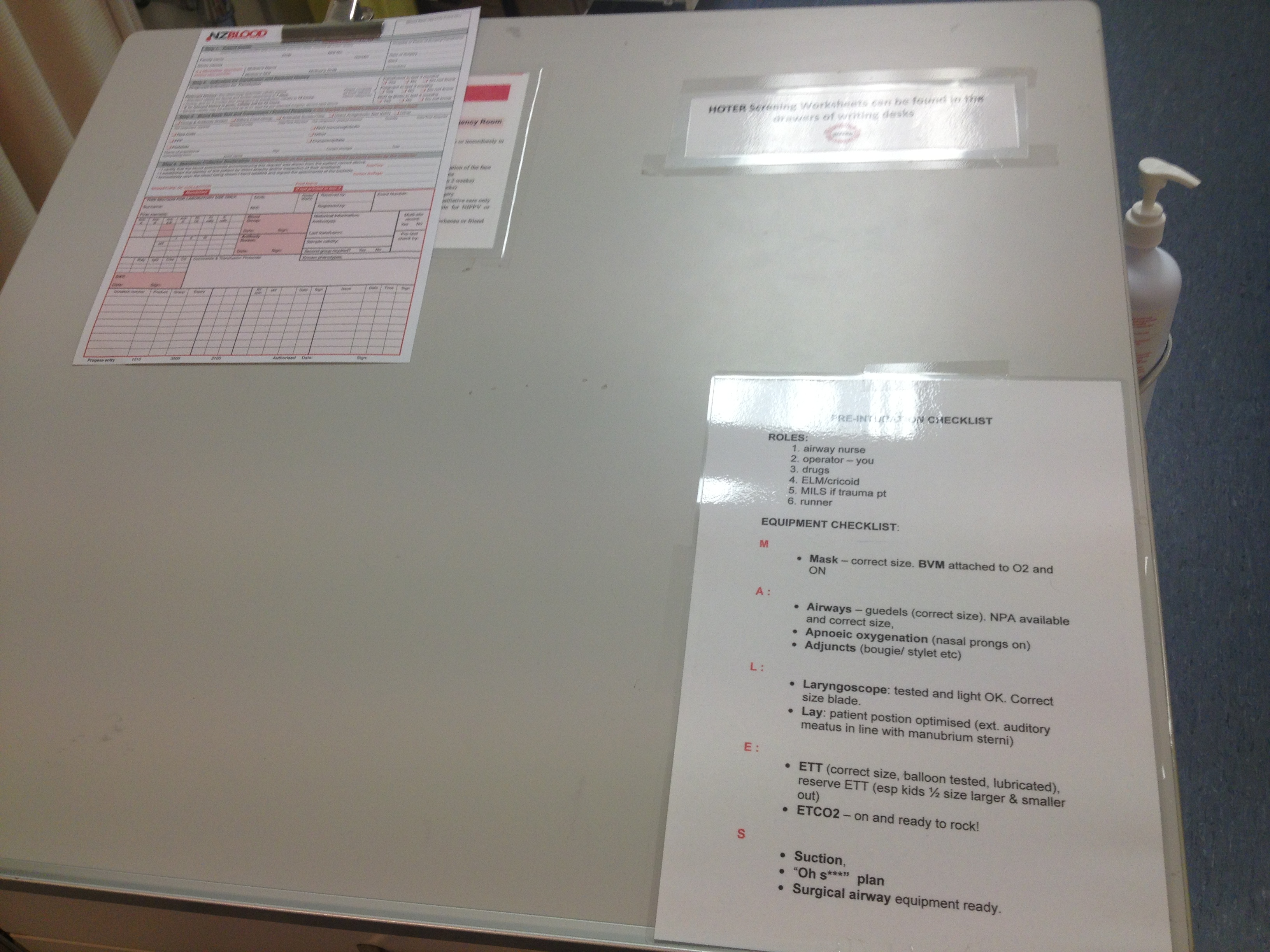
photo(2) copyAlthough this desk is frequently cluttered with paperwork during a resuscitation, accessing the checklist would be a simple matter, and would be done so by a senior person.

After looking at the positioning of these checklists, I came to two conclusions:

1) Simulation is a powerful tool for testing the usability of a new item or technique and identifying hazards

When considering logistics/ergonomics/equipment what actually happens in real life may differ from what we envisage mentally when we introduce something new. Simulation introduces stress, time-urgency, ergonomic elements and personnel elements that can rapidly reveal whether something new is going to be useful or not, or whether its introduction has inadvertently created hazards

2) We need to actively manage the environment we work in

When confronted with a critically ill patient, it is easy to focus on the scenario in front of us (there is usually quite enough to think about there!) and accept the physical environment as it is. By going a step further and ACTIVELY managing our environment to improve logistics and ergonomics we can increase our chances of a good outcome. This can occur both BEFORE we are confronted with a patient (eliminating the latent hazard above, for example) and DURING a resuscitation. This is particularly important in the pre-hospital setting, where both the relatively unforgiving helicopter and roadside environment provide a range of challenges not encountered in a resuscitation bay. As doctors I believe we have a lot to learn from our paramedic colleages in this area.

(NB – if someone becomes angry because that restocking checklist mysteriously disappears this week, I had NOTHING to do with it, nothing at all)

FOAMing at the mouth

(an introduction to FOAM, for people who have no idea what I’m talking about)

Foam03

The rise of the internet over the last 20 years has had a profound impact on both practice and education in medicine. Working in the ED, there is not a shift that goes by without my consulting The Oracle to look something up (usually something that I once knew but have long since forgotten).

Medical material on the internet previously consisted mostly of static web pages and images akin to online reference texts (quality variable!) Now, with widespread access to high speed internet services and newer internet-based forms of communication and information dissemination (twitter, facebook, youtube, podcasts….), the store of medical information on the internet has expanded rapidly. More importantly however, multiple means of communicating online AROUND medical information have led to an international explosion of collaboration on knowledge and ideas. This phenomenon has become known as FOAM (free open-access meducation).

The term FOAM was apparently coined over a pint of Guinness in Dublin in 2012. Surprisingly the people who came up with the idea managed to remember it until the morning, and FOAM has become the term that ties together multiple online sources of medical education. Life In The Fast Lane have a great page describing FOAM here, and describe it thus:

FOAM resources are sophisticated, cutting edge learning resources that enable clinicians and students to update their knowledge and improve their understanding in a fun, motivating and time efficient way. It is all free, and can be accessed by anyone, at anytime, anywhere. We believe that together with asynchronous learning and the flipped classroom, FOAM is the future of medical education and lifelong learning

I am a relative neophyte when it comes to FOAM, having heard the term only since setting up this site (late 2012) and scouring the internet looking for resources that may be helpful for our service.

What has struck me about FOAM is how powerful it is at rapidly promoting, refining, and disseminating knowledge that changes practice.

This landmark paper by Richard Levitan and Scott Weingart was published in the Annals of Emergency Medicine in 2012. It provides a superb review of evidence around preventing desaturation during ED airway management, and contains multiple practical (and evidence-based) tips, as well as introducing some lesser known but highly effective concepts like apnoeic ventilation.

While changes in practice would be expected to result from the publication of a landmark paper in a respected and widely circulated journal, FOAM allows even faster dissemination    of knowledge worldwide. Scott Weingart’s podcast, for example, is downloaded by over 100000 people per episode! The techniques described in the paper above are already being used on a daily basis in the Auckland ED, and are equally relevant to our pre-hospital airway management.

Such a rapid evolution in clinical practice would not be possible without FOAM. Changes of practice that rely on textbooks and journals require a timeframe of years rather than weeks or months. FOAM allows people to learn in a time and manner of their choosing.

FOAM also allows people to add their own personal perspectives and stories to medical educational material. Much of the training performed by Auckland HEMS involves airways (RSI being arguably the most important technical skill the addition of doctors to the helicopter has provided). As such I have read, listened to, and scrounged a lot of FOAM resources regarding airway management for this site. With surgical airways in particular, FOAM has provided me with the following pearls that I would probably never have found in a text or journal:

  • announcing loudly “I can’t intubate, I, cant ventilate, I am doing a surgical airway” is a great technique for honing the focus of the team and getting everyone ‘on the same page’ (and it sounds a but more professional than ‘F$@#’)
  • there is a lot of bleeding during a surgical cricothyroidotomy – so much so that some people have abandoned the procedure! Be prepared for this
  • when performing a needle cricothyroidotomy, setups involving syringes/3 way taps/ETT connectors are not necessary – have a look at this!

Snippets of information like these could make the difference between a good outcome and  death in the event of a failed airway – and yet the chances of finding them outside a FOAM format are probably pretty small. Many thanks to Minh Le Cong and Scott Weingart!

To quote Joe Lex (a highly respected emergency medicine educator):

“If you want to know how we practiced medicine 5 years ago, read a textbook.

If you want to know how we practiced medicine 2 years ago, read a journal.

If you want to know how we practice medicine now, go to a conference.

If you want to know how we will practice medicine in the future, listen in the hallways and use FOAM.”

If you wish to learn more about FOAM, this page is a great place to start.

This is a talk about FOAM by Mike Cadogan at ICEM in 2012:

Plus, of course, SMACC is less than a month away…

Cognitive elements of prehospital intubation

Rethinking_ETI_1

Prehospital intubation has been (arguably!) the most important skill the addition of doctors to the Auckland Westpac Rescue Helicopter has brought to helicopter prehospital care in our region.  While the paramedics in our team are highly skilled and very experienced, none of them are currently RSI qualified. St John Ambulance (the ambulance service provider for most of New Zealand, including Auckland) does have RSI-qualified paramedics, some of whom have worked on the helicopter in past years, but currently the helicopter team cannot perform an RSI without a doctor present. Intubations can be performed by paramedics without drugs however in certain circumstances, usually in cardiac arrest or severely obtunded patients.

With the addition of doctors, we have had a heavy training focus on RSI, including introducing an RSI checklist and actively involving the crewman in the RSI procedure.

This paper, from Prehospital and Emergency Care in 2007, provides an interesting insight into the cognitive processes around prehospital intubation, and the implications for training.

Rasmussen’s ‘Skills-Rules-Knowledge’ framework is a concept that can be applied to many difficult/complex processes. The elements are:

Skills-based processing – task performance that can become ingrained, and performed without conciously thinking about it (for example chest compressions in CPR)

Rules-based processing – when an action or series of actions is executed in response to a certain situation, for example ‘if the patient has no pulse – start CPR’. Rules based processing requires explicit knowledge, and can become difficult if the cues for a certain action are unclear.

Knowledge-based processing – a process that can be applied when rules-based processing fails or is not appropriate. For example, in the setting of cardiac arrest – rules-based processing instructs CPR to begin, knowledge-based processing might allow a decision like “the down-time is over 30 minutes, CPR is inappropriate’.

These three elements are highly inter-related – frequently used knowledge-based and rules-based process may, with experience, become skills-based processes.

With regards to prehospital intubation (paramedic performed), the authors then make the following points:

  • although intubation is often taught as a skills-based process, on closer examination it relies heavily on knowledge-based processing
  • recognition of the need for intubation should theoretically be rules based, however some of the cues involved (assessment of respiratory effort, degree of compromise etc) are challenging and the interpretation may vary between individuals, and there are few clear ‘rules’ for intubation in the prehospital setting, hence it is a knowledge-based process
  • identifying a difficult airway is a knowledge-based process
  • selection of intubation technique (position, equipment) are knowledge-based, the only clear ‘rules’ apply to the sizing of paediatric endotracheal tubes
  • techniques for assessing whether intubation has been successful all aim to provide a rules-based ‘yes/no’ answer as to whether the tube is in the trachea, but all are fallible under certain circumstances. Confirmation of tube position is therefore also knowledge based

Amongst other conclusions (including the need for developing pre-defined “action rules” for common clinical scenarios; developing training that places intubation in the wider context of airway management; and further examining the cognitive processes around paramedic intubation), the authors also ask whether intubation is too cognitively difficult for a paramedic in the prehospital environment, and whether less complex devices would be more appropriate.

So how does this relate to our service?

Given our three clinician model (doctor, paramedic, medically-trained crewman), plus often other ambulance staff, it would be (hopefully!) difficult to argue that a pre-hospital RSI is too cognitively difficult for us.

Thinking about an RSI in terms of skills-based/rules-based/knowledge-based processes is useful however.

The most common way we practise RSI is currently some sort of ‘RSI drill’, involving a team of three. It includes running through our checklist, following by executing the RSI procedure as a simulation. This most closely represents a skills-based procedure. Individual elements of the sequence (laryngoscopy, passing a tube over the bougie etc) also represent skills-based processes. With our simulation lab now up and running (plus 3 new mannequins) we have the opportunity to practise skills-based elements of RSI as often as we wish.

Based on collective experience however (both from clinical practice and training) the most difficult elements of RSI are likely to be the knowledge-based processes – whether an RSI is indicated in certain situations, whether modifications to a standard RSI are required (for example DSI or neuroprotective RSI), and contingencies in the event of difficulties or failure. Given a distinct lack of evidence in many of these areas decisions rely heavily on clinician judgement and experience.

For me, the most important thing to come out of reading the paper above was the idea that we can and should be generating specific rules-based processes tailored to the clinical scenario we are dealing with. In the setting of an RSI, this is crucial for when things are not going to plan. The NAP4 audit of airway failures from the UK found that one of the main contributing factors to ED airway failures was ‘a failure to plan for failure’.

While we have a standard RSI checklist and a sequence of events to follow in the event of a failed airway, we need to (and hopefully already do) go beyond this to consider patient specific elements (for example ‘this patient’s airway burns means a higher chance of failed laryngoscopy and need for surgical airway, I will declare failure after x seconds’, or ‘I expect this patient to desaturate very fast, actions when saturations reach 90% will be x,y,z..)

Anticipating and voicing patient-specific elements and (using the terminology from the study) actively regarding them as rules-based processes should, provided they are generated PRIOR to the proverbial hitting the fan, provide an extra level of safety and decisiveness whan an RSI is not going to plan. With a failing RSI and an increasingly unwell patient, I suspect we would all find it easier to follow a clear, pre-defined, and overtly stated rule or two (that we and our team had tailored for the specific scenario) rather than trying desperately to apply knowledge-based processing too late and under extremely stressful circumstances…

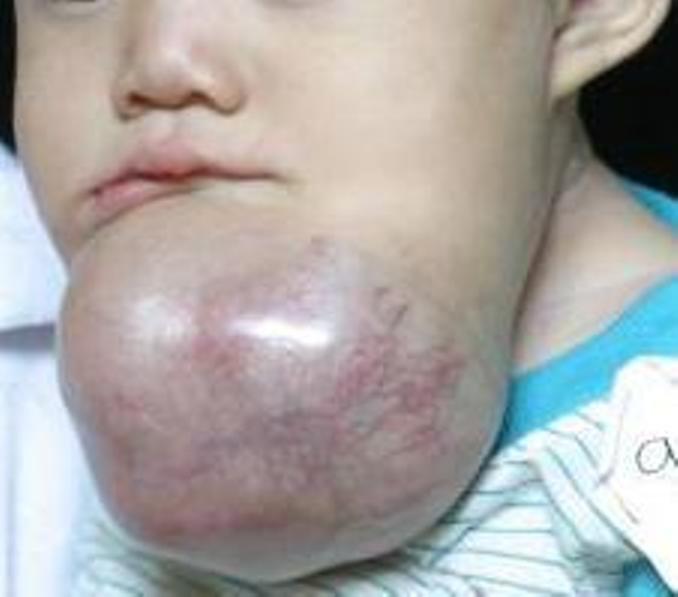
What 'rules' would you generate for intubating this child?

What ‘rules’ would you generate for intubating this child?

The full text pdf for this article is here (secure area limited to ADHB staff – ADHB has subscription access to this journal via the Philson Library at the University of Auckland School of Medicine)

petro82's avatarSim and Choppers

I have written about checklists in medicine before, but in light of a recent publication in the New England Journal of Medicine, I was inspired again to write about it.

One of the leading advocates for checklists in medicine is Atul Gawande. His book “The Checklist Manifesto” is an excellent read for anyone interested in the topic and definitely well written for the lay-person. Notably he’s also the senior author on this randomized trial just published in NEJM. And while the NEJM is often busy publishing some questionably biased and often pharma-funded studies, this one deserves attention. But before I discuss more about the trial…I digress…

Just this week, while we were flying I observed something quite interesting. Typically when we fly in the helicopters, our pilots ask our crewman for landing checks. At which point the crewman will go through the checklist with the pilot answering appropriately. We…

View original post 660 more words