Prehospital management of pelvic fractures

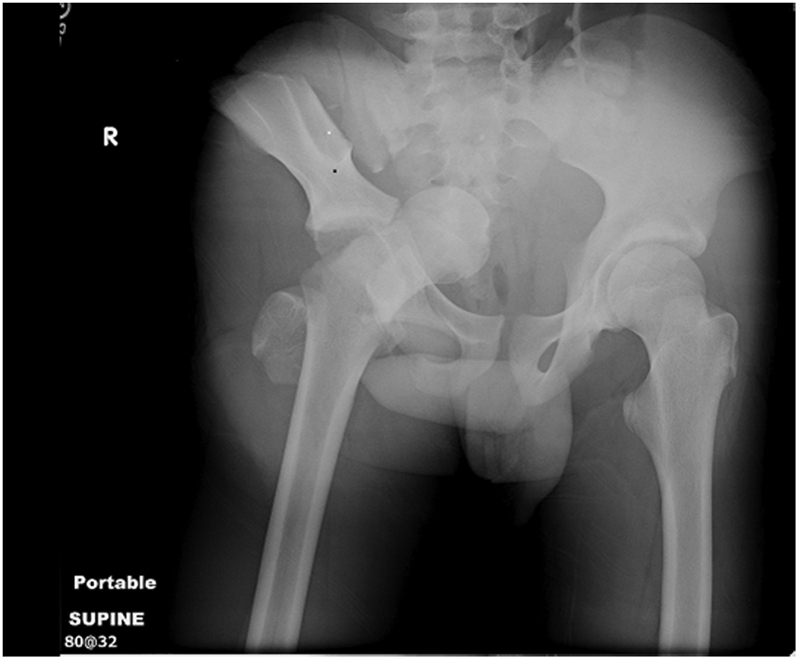
Will a pelvic binder help this?

Will a pelvic binder help this?

In the New Zealand trauma setting, blunt trauma is by far the most common mechanism. In the Auckland region it is not uncommon for us to manage patients with major pelvic trauma in ED (most commonly as a result of road trauma), and with the advent of the HEMS service our team are now dealing with this in the prehospital setting as well. The most notable case transported by the Auckland HEMS service in the last year involved a middle aged patient with a free-floating pubic symphysis (open bilaterally with actively bleeding groin wounds), a sacral fracture, and an ED arrival blood pressure of 66/40…)

This paper, published in 2007 by a UK trauma service, provides a nice overview of the prehospital management of pelvic trauma.

Take-home messages:

  • In patients who are obtunded (and therefore have an utterly unreliable clinical assessment) a pelvic fracture should be assumed to be present and a splinting device placed
  • in conscious patients, the presence of pelvic pain is a more reliable indicator of a fracture than palpation or compression of the pelvis
  • Reduction and stabilisation of pelvic fractures should occur as soon as possible after injury, while clotting mechanisms are still intact
  • Bleeding from pelvic fractures should be considered to be non-compressible, and therefore permissive hypotension (resuscitation to the presence of a radial pulse only) should be considered as a resuscitation strategy; NICE guidelines recommend 250mL boluses titrated to the radial pulse
  • There is a risk of patients becoming haemodynamically unstable following full log-rolls for spinal assessment (this has been reported in the ED setting); in the prehospital setting a roll to 15 degrees only will allow placement of a scoop
  • the handover to medical staff in ED should include advice not to remove the splint until a significant injury is excluded, including the fact that pelvic splints can provide excellent anatomical reduction leading to fractures potentially being missed and displacing once the splint is removed

The following is an instructional video showing the use of the SAM Sling, which is carried as standard kit on our helicopters:


Oxygen physiology and pulse oximetry lag podcast

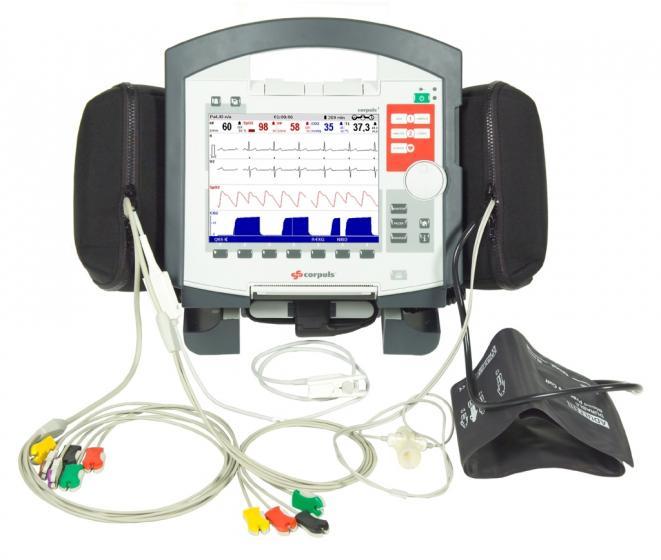
corpuls

This podcast, from the Scott Weingart’s superb emcrit.org site, discusses the lag between oxygen delivery commencing following RSI and the rise in saturations on the patient monitor. It is directly relevant to the prehospital setting, given that a colder environment and a shocked/underresuscitated patient results in a longer pulse oximetry lag. The discussion also makes note of several cases where a (probably) successfully placed ETT was removed in the prehospital setting due to pulse oximetry lag.

The emcrit show notes are here

The podcast is here


Ever done an RSI in a helicopter? Here’s a recent simulation experience!

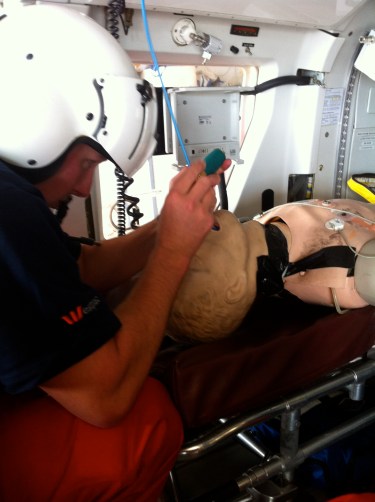
Recently at the base, we’ve been discussing the concept of improving our ergonomics and making our workspace (e.g. the helicopter) as functional as possible. We are continually looking to optimize our equipment to best serve our patients.  Any procedure in-flight will be considerably more difficult than if performed in a well controlled environment like the hospital so in-situ training within the helicopter is essential.

Today, Karl (one of our advanced paramedics) and I did some in-situ simulation of an RSI within the helicopter. We ran through a scenario with an unpredicted deterioration of a patient in flight that required an RSI. A review of the literature provides little guidance on the emergency airway management of patients while in-flight so approaches to such situations currently must be derived from simulation and retrospective reviews within your own program.

We discussed a few key concepts that should be considered as we move forward in pre-hospital airway management and overall care for acutely ill patients:

1. Patient positioning: ample evidence that patient’s should probably have some head elevation if possible during intubation (If you don’t believe me…check out this must read paper). This IS possible within the BK and it actually provided Karl with the best view when it was up near 40-45 degrees! Check out the following pics which demonstrates feasibility within the BK.

Patient is fully supine. Experts advocate "ear to sternal angle" but in our traditional position of supine you'll note that the ear is NOT at the sternal angle!

Patient is fully supine. Experts advocate “ear to sternal angle” but in our traditional position of supine you’ll note that the ear is NOT at the sternal angle!

And now, for a clear demonstration of “ear to sternal angle”. A position we should strive to do either to avert intubation or in preparation of an advanced airway.

A picture perfect view of the cords!

A picture perfect view of the cords! Patient at 40 degrees, and still able to intubate with a great view…even with the helmet on. Let’s integrate this!

2. Pack position: we decided that the airway/BMV pack would be removed from the Thomas pack and given to the intubating clinician immediately upon patient deterioration. This allowed the paramedic to have all necessary equipment for excellent airway management. The physician could then focus on drug administration and clinical decision making. We opened the Thomas pack fully beside the physician and placed the drug pack on the patient’s legs.

Note the drug pack on the patient's legs and the Thomas pack spread out to the right of the physician. This worked best in our setting.

Note the drug pack on the patient’s legs and the Thomas pack spread out to the right of the physician. This worked best in our setting.

Here’s what DIDN’T work.

This set up was very cumbersome if the drug pack is lying on a partially open Thomas pack. Another issue was the Thomas pack was still upright...and not lying flat.

This set up was very cumbersome if the drug pack is lying on a partially open Thomas pack. Another issue was the Thomas pack was still upright…and not lying flat. Also harder since we had to turn each time to get drugs rather than in front.

3. Apneic oxygenation: this is a bit trickier and something we’ll have to look at more closely to see what would be feasible since it will require 2 O2 sources. It was definitely challenging to get it set up when time constrained. (another must read paper on the value of apneic oxygenation).

Huge thanks to Karl for running through the sim case and providing value feedback on the ergonomics of the situation…what worked and what didn’t! We will all learn from this.