Tag Archives: Simulation
Ever done an RSI in a helicopter? Here’s a recent simulation experience!
2
Recently at the base, we’ve been discussing the concept of improving our ergonomics and making our workspace (e.g. the helicopter) as functional as possible. We are continually looking to optimize our equipment to best serve our patients. Any procedure in-flight will be considerably more difficult than if performed in a well controlled environment like the hospital so in-situ training within the helicopter is essential.
Today, Karl (one of our advanced paramedics) and I did some in-situ simulation of an RSI within the helicopter. We ran through a scenario with an unpredicted deterioration of a patient in flight that required an RSI. A review of the literature provides little guidance on the emergency airway management of patients while in-flight so approaches to such situations currently must be derived from simulation and retrospective reviews within your own program.
We discussed a few key concepts that should be considered as we move forward in pre-hospital airway management and overall care for acutely ill patients:
1. Patient positioning: ample evidence that patient’s should probably have some head elevation if possible during intubation (If you don’t believe me…check out this must read paper). This IS possible within the BK and it actually provided Karl with the best view when it was up near 40-45 degrees! Check out the following pics which demonstrates feasibility within the BK.
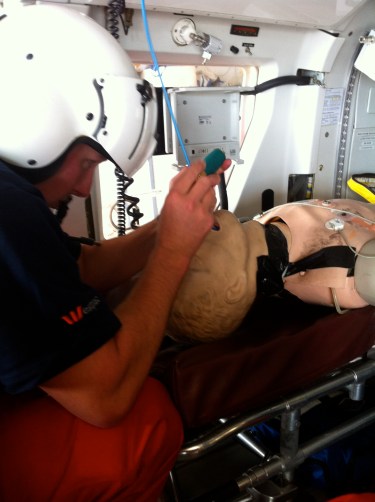
Patient is fully supine. Experts advocate “ear to sternal angle” but in our traditional position of supine you’ll note that the ear is NOT at the sternal angle!
And now, for a clear demonstration of “ear to sternal angle”. A position we should strive to do either to avert intubation or in preparation of an advanced airway.

A picture perfect view of the cords! Patient at 40 degrees, and still able to intubate with a great view…even with the helmet on. Let’s integrate this!
2. Pack position: we decided that the airway/BMV pack would be removed from the Thomas pack and given to the intubating clinician immediately upon patient deterioration. This allowed the paramedic to have all necessary equipment for excellent airway management. The physician could then focus on drug administration and clinical decision making. We opened the Thomas pack fully beside the physician and placed the drug pack on the patient’s legs.

Note the drug pack on the patient’s legs and the Thomas pack spread out to the right of the physician. This worked best in our setting.
Here’s what DIDN’T work.
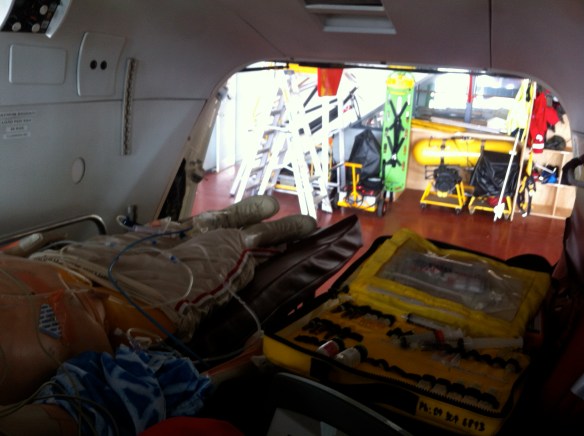
This set up was very cumbersome if the drug pack is lying on a partially open Thomas pack. Another issue was the Thomas pack was still upright…and not lying flat. Also harder since we had to turn each time to get drugs rather than in front.
3. Apneic oxygenation: this is a bit trickier and something we’ll have to look at more closely to see what would be feasible since it will require 2 O2 sources. It was definitely challenging to get it set up when time constrained. (another must read paper on the value of apneic oxygenation).
Huge thanks to Karl for running through the sim case and providing value feedback on the ergonomics of the situation…what worked and what didn’t! We will all learn from this.
Simulation Exercise Thursday 6 December – Equipment Usability Testing

Did that cursed plastic mannequin expire last time despite your best efforts to resuscitate it?
Well, here is your opportunity to try again!
WHAT: Equipment Usability Testing
WHEN: Thursday 6th December, 1900-2130
WHERE: Marine Rescue Coordination Centre, Mechanics Bay
The focus for this exercise is not to assess you or your team’s performance, but to assess different equipment configurations. Sam Bendall has once again cooked up a variety of fiendish scenarios that will force you to raid the deepest recesses of your medical kit.
With a variety of kit configurations to try, the aim is to build on the learnings from the Brown’s Island simulation exercise and explore how our equipment could/should be improved.
This is YOUR opportunity to experiment with different kit configurations and have a say in which direction the HEMS medical kit should go.
See you there!
Petro’s Prehospital Practice (session #2) A success!
Thursday’s have turned into our structured simulation day at the helicopter base. Part of my learning objective at ARHT (in Auckland) is to improve my abilities in running and debriefing simulation scenarios. While the group has (and continues) to run impromptu simulation sessions we have moved to a structured aspect that will allow us to be creative and try new things. We have the luxury of our Rescue Helicopter Trust being the subject of a TV show so there’s an abundance of footage of previous jobs. Today we selected a scenario from a previous episode that was viewed by the sim team before starting (check it out all the episodes here). This set the scene and we immediately jumped right into the scenario. The team stormed out to the scene and within minutes were immersed within the scenario. Check out a few pics from the scenario below.

- Scott and Ati working hard during a V. Fib arrest. Great to see Scott providing some solid CPR!

- The debrief – doing my best to keep people interested! Do you think they were listening?


The duty crew for the day formed today’s team and it was comprised of three members who did an awesome job! We had great teamwork from all three; Ati (crewman), Ross (Advanced paramedic), Scott (HEMS physician). Two key themes emerged from the day:
1) Role assignment and leadership: sometimes pre-assignment of a leader in the pre-hospital setting can be disrupted depending on available personnel (or lack thereof). The team decided as long as it’s well verbalized that there’s going to be a transition in leadership that it shouldn’t be an issue
2) Ergonomics: Placement of equipment and personnel is super important for being efficient and maximizing speed. Following the scenario we examined the set up the team had established then looked at ways to improve it. Chris Denny (HEMS physician supervising the scenario) spoke of using the stretcher as “table” and the use of angles as a strategy to improve scene ergonomics.

This session was a great opportunity for me to practice my debriefing skills using some stuff from the Harvard Simulation group. The idea of advocacy-inquiry method moves away from the idea that we shouldn’t judge during debriefings. Instead, the debriefer can provide an opinion but at the same time they try to understand how/why the learner decided to make such a decision even it may have been incorrect or controversial. “The instructor can help the learner reframe internal assumptions and feelings and take action to achieve better results in the future” (Rudolph JW et al. Simul Healthcare 2006).
 Auckland HEMS