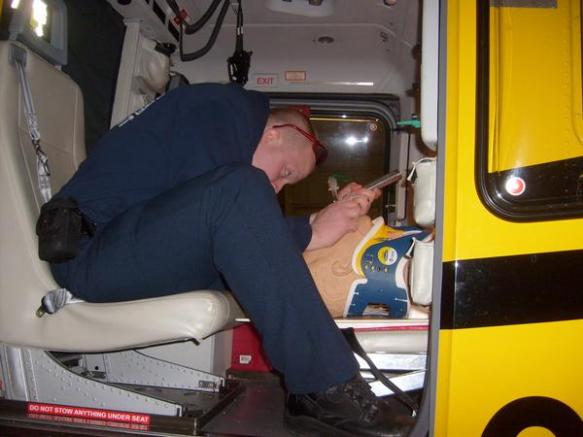
Intubation practice in a helicopter – no seatbelt, life jacket, helmet, or comms
At a recent job I attended with one of the paramedics, we transported a patient with an arrhythmia to a hospital 35 minutes flying time away. The patient had experienced chest pain and pre-syncopal symptoms that day, and when seen by the local doctor had a narrow complex irregular rhythm with a rate of up to 230/min. The doctor administered some adenosine with no effect, followed by 150mg of IV amiodarone, which slowed the rate to 150/min. With no chest pain and a stable BP, we felt the patient was stable enough for transport, and departed the scene.
Shortly after takeoff, I realised that should the patient require BLS or ALS interventions in-flight, the ergonomics would have been extremely limiting, for two reasons:
1) the already cramped interior was even more cramped than usual – the rear compartment contained the patient, their spouse, myself, the paramedic, and the cameraman
2) the seating arrangement we had was probably the worst possible for performing interventions – the patient’s spouse was in the head (airway) position, the cameraman was to the patient’s right side (other interventions), and the paramedic and I were tucked away behind the patient’s right shoulder. In the event of the patient deteriorating, access to perform interventions would have been extremely difficult.
Aside from concluding that I needed to actively consider seating positions for all the jobs I attend, even in ‘stable’ patients, this case left me wondering about the ergonomics and logistics of performing significant interventions in the back of the helicopter, especially BLS/ALS and airway interventions. Discussing in-flight arrest with the paramedics revealed that several of them had dealt with this problem, with performance of interventions being very difficult (one was forced to do chest compressions with his elbow, due to a lack of overhead room), a good outcome was felt to be unlikely, and that landing (if possible) may be the best way to carry out an effective BLS/ALS sequence.
Following this Andrew Petrosoniak and I conducted a highly (un)scientific study by placing a head/torso mannequin on the stretcher in the helicopter to see how it felt performing interventions (note – detachable limbs were NOT part of Laerdal’s original features on this model of mannequin!). What we discovered was that the positioning and room available for airway intervention actually seemed pretty good, whereas chest compressions were extremely difficult. The lack of overhead room meant that it was not possible as a rescuer to put your body weight on the patient’s sternum via straightened arms. The ‘elbow’ technique worked well, although fatigue rapidly became an issue, and whether the chest was being allowed to decompress sufficiently was unclear.
Reviewing the literature around BLS/ALS interventions proved fairly surprising. There is a fair amount of evidence specific to the BK-117, which suggests that the efficacy of BLS/ALS interventions is actually comparable to what can be achieved in a ground ambulance.
Two examples of BK-117 specific literature are:
The ability to perform closed chest compressions in helicopters – a study published in 1994 that showed that chest compressions in the BK-117 were as effective both in-flight and while stationary on the ground as in a control environment
Effect of an in-flight helicopter environment on the performance of ALS intervention – Another study published in 1994 which showed that the time taken to perform ALS interventions in the BK-117 was no different to the time taken in a ground ambulance.
The addition of a HEMS doctor to the flight crew, plus a cameraman for a significant part of the year, means that for many jobs (including the one I have detailed above), the crewman is placed in the co-pilot seat, leaving a team of two ALS-qualified clinicians with the patient. ALS algorithms generally require a team of three, but evidence from simulation suggests that an ALS algorithim can be successfully run by two rescuers, such as in this study published in 2007 – Two rescuer resuscitation – mission impossible? A pilot study using a mannequin setting. Their algorithim involved the person at the head position providing BLS while the person at the side prepared ALS interventions, and the two then performed ALS together.
Our perception that access to the airway for intervention was reasonable also seems supported by evidence, for example the study about ALS interventions above, however ‘difficult’ intubation in a helicopter has a very low success rate. Airway intubation in a helicopter cabin: video vs. direct laryngoscopy in mannequins is a study published in 2009 comparing intubation via direct and video laryngoscopy in standard and ‘difficult airway’ mannequins , which recorded a success rate of only 5% on the ‘difficult airway’ mannequin with direct laryngoscopy intubation. The standard mannequin had a success rate with direct laryngoscopy of 95%.
More unconventional methods of intubating patients in-flight have also been studied. Inverse intubation in air medical transport, published in 2004, examined the success rate of ‘inverse intubation’ inside a BK-117, with the operator straddling the patient’s chest and inserting the laryngoscope with the right hand in an overhand position. There was no difference found between the time to intubate and the number of attempts required to intubate for the inverse and conventional methods of direct laryngoscopy.
There are of course multiple caveats to applying the information above, mostly derived from ground simulation, to our operational environment. Environmental effects (poor light, turbulence, inclement weather, vibration, noise) and aeromedical fatigue from operational jobs and varying shift patterns would probably affect performance of significant interventions. The sustainability of effective intervention (for example whether you could perform effective ALS on a 35 minute flight back from Great Barrier) in the operational environment is unclear. Whether a sudden deterioration or cardiac arrest was anticipated (and therefore planned for) would have a huge influence on the time to effective intervention.
Nonetheless, the recent addition of a HEMS doctor to the flight crew, plus the crew members now being required to be BLS-certified and beyond provides a significant increase in the skill and experience available to a critically ill patient in-flight. To take advantage of this we should practice it.
My conclusions:
1) the evidence suggests that (in theory) we should be able to perform effective BLS, ALS, and advanced airway intervention (excepting difficult airways) in the rear of the BK-117
2) While prior paramedic experience with this in practice has not been particularly favourable, there is now an fortified skill mix plus an extra clinician available to the patient which may lend itself to a more favourable outcome
3) High fidelity simulation (including real-time measuring of effectiveness/sustainability of CPR) in the helicopter interior (with lifejackets, helmets and comms) would be a perfect way of assessing the clinical, logistic, ergonomic, and CRM elements of in-flight emergencies, and may help provide an guidance as to whether or not the helicopter should land (if the option is available) – this is clearly a key decision.
Watch this space (and be very afraid…)
Scott Orman
Full-text pdfs for this post are available here (secure area limited to ADHB staff only – ADHB has subscription access for staff to these journals through the Philson Library at the University of Auckland School Of Medicine)






 Auckland HEMS