“Total Immersion” Simulation…..!!

The Auckland Rescue Helicopter Trust (ARHT) works with multiple agencies, including NZ Defence, and has the good fortune from time to time to train alongside these groups.

On the 14th May we were invited to train in the ultimate in-situ simulation venue – the Royal New Zealand Navy Damage Control School with the RNZN Sea Safety Training Squadron. This involved fire training and vessel damage control (for this read blocking lots of holes letting water into a ship simulator…!)

Present were 5 ARHT crewman, our physical instructor, and several representatives from the New Zealand Police Search and Rescue unit.  I went along as the HEMS medic representative and to get an idea of how in-situ simulation is conducted in other services.  It was the epitome of a multidisciplinary team!

We started with the Fire-Fighting Training Unit (FFTU). After instruction of the use of the differing methods of fighting fires, donning fire-retardant suits, gloves and masks we firstly made up our own foam fire extinguishers, then used them on a gas fire. We also did the same on oil and diesel fires with fire blankets, CO2 extinguishers and lastly dry powder extinguishers.

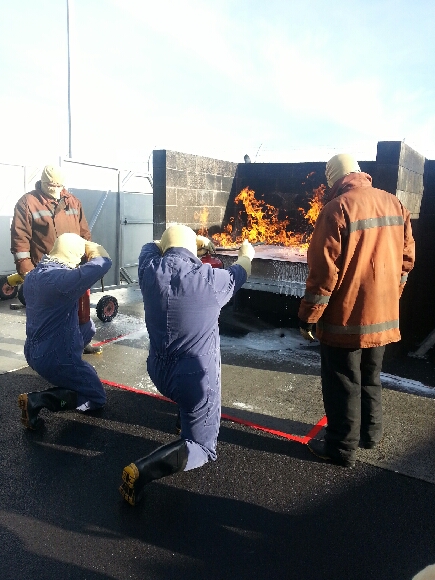
fightingfire

alanafightingfire

We then moved on to the Damage Control Training Unit (DCTU).  After some brief instruction on ‘shoring up’ methods (how to block leaks in the ship), we moved into the unit for a tour before the real fun began. The DCTU is a faithful recreation of a section of a ship three decks high.  It is used to train Navy personnel in Damage Control (leak stopping and removal of flood water) and casualty evacuation. The DCTU uses hydraulics to simulate the rocking motion of a ship at sea; this enables students to experience the problems which can arise from the combination of motion and free surface water.
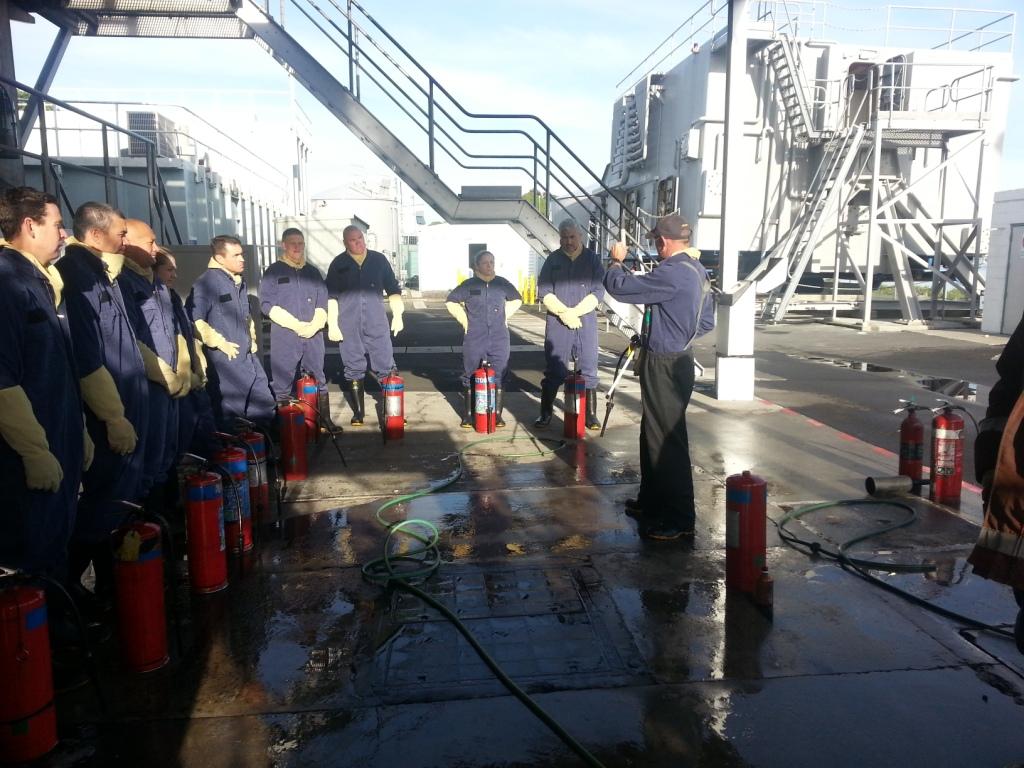
navy                                                               (The Simulator is is the background of this picture)

I was appointed team leader for my team of 7 – I was reliably assured this was due to me being small (5′), mouthy and Irish… It was a rather daunting prospect.  Even with the training and experience I have in a leadership capacity; I was now leading a team of people in something that I had no prior experience or knowledge of.  Add in the team-mix as described above, then lock us all in a confined space, with freezing cold water pouring (under massive pressure) in through multiple holes in the walls, roof and floor, plus darkness, smoke, noise and the motion of a rocking ship – doubly daunting…

Not surprisingly it was extremely difficult to keep overall situational awareness – I did most of the team leading being “hands –off”, but with my backside blocking a leak in the wall!  Despite this the team worked together brilliantly. We had allocated roles beforehand.  There was great use of closed loop communication, once a job was done those free returned to the team leader for further task allocation.  We managed to shore up all the major leaks in the engine room (where we started) then moved to help the second team out in the mess hall with further leaks.  We finished in waist deep water (waist deep if you were 6ft tall that is…!).

Escape was though an overhead hatch, weighed down by water from leaks in the decks overhead – again great teamwork was put to use getting the stronger team members up a rope ladder first to open the hatch against pressure and then help the rest up through the subsequent torrent of water.

There are cameras all through the DCTU – everything was filmed, the footage is then usually viewed in a de-briefing session following the scenario.  Unfortunately due to time constraints we didn’t manage to see the footage from our exercise.

A few colleagues were wondering what exactly an emergency medicine / HEMS doctor was doing on a Navy damage control exercise as (to quote) “it’s not something you’ll ever need to do… the ED is hardly going to sink…”.  However I feel there were multiple comparisons to this training and what we do every day in the workplace, be that in the ED or on the helicopter.  In-situ simulation aside, today proved an invaluable crisis resource management and team-building exercise for the ARHT group.  14 people from different services, with differing physical attributes and prior experience working together in a completely alien environment, doing something they have never done before…  It suddenly dawned on me this was no different to your usual gnarly trauma resuscitation crew on an ED night shift, except with maybe a few more lives at stake!

For more insight into how other high-performance services train to mitigate for the “fallibility of the human mind under great pressure” and how this can be translated into healthcare, see this post from the blog Resus Room Management. This has a link to the BBC Horizon documentary “How to avoid mistakes in Surgery” where Kevin Fong (a well-known Anaesthetist and Intensivist from the UK) explores human factors in medicine.

I would like to thank the instructors from the RNZN Sea Safety Training Squadron and also ARHT crewman Ati Wynyard for organising this very worthwhile training day.

The benefits of HEMS – more than just statistics!

As demonstrated by the previous post, studies that show a benefit for HEMS receive significant exposure within the medical and prehospital community. Due to the nature of the work, often relatively short times providing care to patients, and heterogeneity of patient/pathology/environment, benefits in terms of statistically significant improved patient outcomes are difficult to demonstrate.

In this post, I thought I’d outline some of the non-measurable benefits that have resulted from the advent of the Auckland HEMS (specifically by combining the existing paramedic/crewman team with a hospital-based doctor).

1) Improved understanding influencing ED care

Those of us who have ventured into the prehospital environment have gained a new understanding of the specific challenges involved, including those around the interface between the prehospital and hospital environment. With our newfound experience and the guidance of our paramedic colleagues from St John and ARHT, the way patients are handed over by prehospital staff and received by ED staff has evolved. This is best explained in this post, which contains a video demonstrating an effective handover template and use of a whiteboard for significantly unwell patients. As an ED doctor receiving patients and leading a resus team , this sort of process feels like  significant improvement in patient care – even if proving it with statistics would be just about impossible!

8312-0057

Auckland ED ambulance bay

2) More communication and teamwork

While working in HEMS, we have built relationships with pilots, crewmen, paramedics, and other ARHT employees. What has been surprising however is the extent to which communication has changed between ED doctors (not just the HEMS doctor team) and our St John paramedic colleagues who are NOT directly involved with the Westpac Helicopter. In addition to evolved handovers as discussed above, there seems to be a lot more dialogue between paramedics and doctors in our ED. We are fielding more questions and requests for feedback about patients that are delivered to us, more clinical queries and requests for information in general, requests for paramedics to attend ED mortality/morbidity reviews where appropriate. Speaking for myself, this a two way process – with more of an understanding of how the prehospital setting works, I can now request additional information from paramedics with the aim of improving the care I deliver.

Recently, the benefits of more communication and dialogue were demonstrated to me when two St John paramedics who had delivered a critically ill trauma patient became active resus team members a considerable time after their handover. I was leading a team dealing with severe haemorrhagic shock, a massive transfusion requirement, extremely poor vascular access, a reduced LOC, and a predicted difficult airway. The patient also had multiple long bone fractures, and with all the doctors in my team tied up dealing with the other issues, the two paramedics rapidly and effectively splinted the fractures for me. (Thanks guys – and feel free to leave your Sager traction splint in the ED annnnny time you like…!) I am unsure whether this sort of collaboration would have occurred prior to the ‘cultural change’ that seems to have arrived since the advent of HEMS, but now it feels like there are no barriers in place.

A valuable addition to the ED team..

A valuable addition to the ED team..

3) Active safety management

Placing hospital-based doctors in an aeromedical setting exposes them to the systems required in aviation, including those regarding safety management (watch this video if you haven’t already!) Medicine is traditionally some years behind aviation with regards to active safety management, and while aviation systems cannot be directly be ported directly to medicine (this, plus the process of moving on from aviation learnings into ED-relevant material is discussed on Resus Room Management – a great site that is well worth a look), there is much we can learn.

The involvement of the helicopter crewman in the medical resuscitation team lent itself well to checklist use (crewman have a lot of experience with checklists!), and the Auckland HEMS RSI checklist was the end result. The familiarity with checklists has started another culture change in our ED, and people are starting to realise their value. While Auckland ED has not yet adopted a formal RSI checklist, versions are already being used in our resus rooms, and have the potential to significantly improve the safety of our advanced airway management.

Involvement in HEMS has also allowed the medical team to gain experience with an online safety management system. ARHT uses Air Maestro, which is now being used by the trust to cover medical as well as aviation issues (many thanks to Armin Egli and Paul Robinson for sorting this one out!). While introducing something like this to ED would be a difficult undertaking, gaining experience with it through HEMS allows us to explore the medical uses while seeing in real-time how it improves the safety of aviation operations. Food for thought…

The comments above represent my thoughts about some of the non-measurable benefits of the Auckland HEMS trial. I’d love to hear your thoughts, please post comments below if you wish.


The first ARHT case-based learning session!

This past week, we conducted the first ARHT case-based learning session for the duty crew!

While “case-based learning” may seem like a bunch of educational jargon…it can be rephrased to “sit around the table, discuss a previous job and consider the “what if” “.

I think at this point I was trying to convince people that I wasn't full of BS!

I think at this point I was trying to convince people that I wasn’t full of BS!

We assembled the team for the day which included the crewman, paramedic and doctor for a 45-50 minute session in the board room.  A huge thanks to Russell C, Leon, and Scott O. who all participated and they generated a great discussion about several aspects of this case. (next time we’ll be looking to get our pilot involved too!)

I had the opportunity to facilitate the session which was based on a relatively straight forward job that I had selected. The job involved a patient with a head injury and the focus was on the management of traumatic brain injury in the pre-hospital setting. But amazingly, the discussion covered tons of ground and we discussed all different aspects from before we leave the base, to the time we arrive at the hospital. Much of the discussion focused on CRM ideas which was very interesting.

Our team's paramedic and crewman in deep thought! We must have just been getting to the interesting part! At least the team isn't asleep!

Our team’s paramedic and crewman in deep thought! We must have just been getting to the interesting part! At least the team isn’t asleep…

Here’s a summary of our lively discussion!

Pre-job briefing: unless it was a water job (or extra equip is required) that this could/should be done en route
On scene time: Something we need to address as a team given some growing evidence that scene time doesn’t impact mortality in blunt trauma
Decision making for RSI: time to hospital played considerable role in whether to perform an RSI
Role assignment in RSI: crewman should probably be tasked with RSI checklist and scene management rather than involved in being hands-on during RSI. The doctor should hand the bougie & endotracheal tube to paramedic though  good discussion resulted about this and may be situation dependent
Team position in flight: discussion whether person who intubated should remain at head of bed (even if it was MD) during flight. Consensus that if patient is requiring infusions etc…then MD should be at the side, with paramedic at the head and crewman to his right.

We’ll be looking to roll out a few more sessions in the new year.

Some feedback from the session regarding logistics

  • Using previous jobs to generate discussion is good
  • Focus will be on picking jobs at random to improve learning but this will NOT be a means of quality assurance or control
  • Short sessions will be the goal: 20-30 minutes
  • Getting the whole team together is best, that includes the pilots!
  • All members felt this was a valuable exercise and would participate in future sessions

Again, thanks to the duty crew that day and Scott O for the pictures. See you all in the New Year.